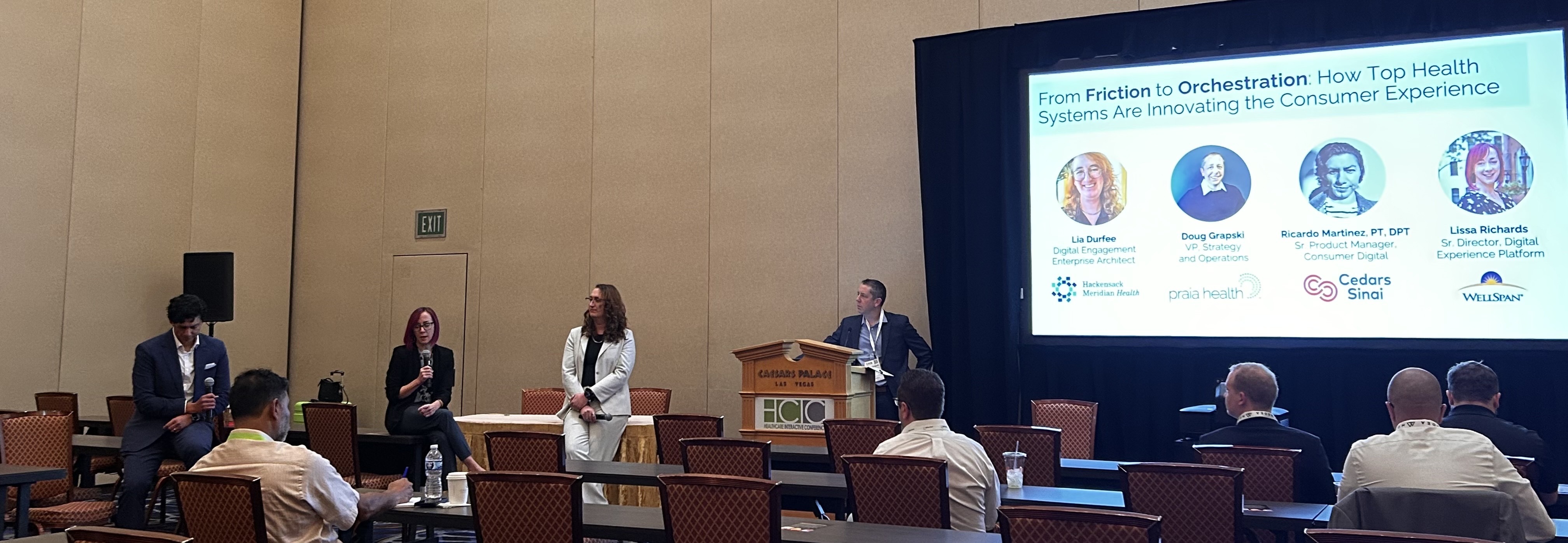

At HCIC25, leaders from Cedars-Sinai, WellSpan Health, and Hackensack Meridian Health joined Praia Health’s Doug Grapski to discuss how health systems are moving past fragmented digital touch points and toward fully orchestrated consumer experiences.
Across organizations, technology stacks, and operating models, one theme stood out: health systems can no longer rely on the EHR portal alone to deliver the digital experience consumers expect. The systems that win in the next decade will combine identity, orchestration, and personalization to drive deeper relationships beyond episodic care.
Below are the session’s biggest insights:
Why the Patient Portal Isn’t Enough
Panelists agreed that EHR patient portals remain essential, but are ultimately insufficient for owning the consumer experience. Ricardo Martinez, Sr. Product Manager, Consumer Digital, at Cedars-Sinai noted that the portal’s limitations show up quickly when organizations try to build deeper engagement:
“The feature set for patient-facing technology on the EHR side often falls short. Patients are looking at lab results. They're looking at messages from their doctor. Maybe they're scheduling appointments. Is that all the value that we provide for our patients in an authenticated space? Or is that where the bar is from what the EHR technology has enabled for us?”
His question framed a larger industry shift: the authenticated environment must become a relationship-building engine, not just a repository for clinical data.
For WellSpan, the challenge is that so many meaningful touch points happen outside traditional care encounters. Lissa Richards, Senior Director, Digital Experience Platform, emphasized that the lifetime relationship with a consumer can’t be contained inside patient portals alone:
“Our engagements with consumers aren't just clinical. We have community engagement events, folks are attending healthy cooking classes, support groups, or smoking cessation. We interact with patients outside of just their individual moments of care, and none of that lives in the EHR. Breaking outside of that is the only way we're going to get a 360-degree view of our consumers. The features and functionality being added to MyChart are great for individual episodic needs, but not over a lifetime of a relationship with a consumer.”
Lia Durfee, Digital Engagement Enterprise Architect at Hackensack Meridian Health, shared that external forces have taken control of the top of the funnel.
“I see a loss of control of the patient experience today in terms of how Google, Bing, agentic search, and AI overviews are taking over our experience. We have a really great website and a lot of really good content. But when our patients are searching for an orthopedic surgeon near Jersey City, they're seeing provider listings and appointment slots. They're getting right to our booking page. They've never seen any of our lovely, crafted content. We're trying to pivot towards a curated experience for patients. We want them to see the events that we have in the community for them. We want them to have learning opportunities. But how do we do that when that power is being taken away from us every day by search engines and agentic AI?”
Health systems need new ways to insert brand voice, guidance, and curated content throughout a patient's journey, regardless of where it starts.
Why Health Systems Want to Own the Experience
Beyond modernization, panelists pointed to deeper strategic reasons for wanting to expand beyond the constraints of the EHR patient portal: brand differentiation, trust, and better clinical guidance.
Lia Durfee highlighted how generic portal design erodes brand distinction:
“Our MyChart looks exactly like other health systems’. Just different colors and a different logo at the top. Those lab results? You have to scroll. You're going to have to dig for them.”
If every health system looks the same, the digital experience stops being an extension of the brand and becomes simply a utility.
Richards underscored how the patient portal alone limits WellSpan’s ability to communicate in its own voice or persuade patients toward high-value actions:
"We can't talk to people in the voice we've established for the WellSpan brand. We can't have consistency of experience. We can't control anything in the patient portal. The patient portal and our public website are two different products. We have to send consumers from one to the other, and they're moving into spaces that we can't control. In MyChart, if you dig through the menu, you'll find your list of things [to do], and it's just a checklist. We want to be able to persuade. Why is it important for you to get that overdue colonoscopy or overdue mammogram? We lose a lot of the ability to use our voice.”
Panelists collectively made the case that health systems need digital spaces where they can contextualize data, motivate action, bring in their brand identity, and shape the care journey holistically, not merely display EHR fields.
The Shift Toward Personalization and Orchestration
To reclaim the patient relationship, organizations are increasingly embracing unified identity, curated content, and cross-platform orchestration. Durfee described HMH’s move toward a more cohesive cross-platform experience:
“I want our patients to forget about the experience. It shouldn't be something that they have to think about. We have different layers that are going to enable us to create a more custom experience without going full ‘yo-yo', as Epic likes to call it. We want to use MyChart as our source of truth for patient identities. And we want them to actually log into our website and get a truly personalized experience that's tied into our CRM and event management platform. [Patients] don't want to look through pages and pages of data about our endocrinologists. They just want to make an appointment.”
Building the Infrastructure: Identity, APIs, and the “Half-Yo-Yo” Approach
All panelists acknowledged the tension between building fully custom experiences ("yo-yo") and relying entirely on the patient portal’s default interface. Most are now landing somewhere in the middle. Durfee described HMH's evolution:
"We've gone ‘yo-yo’ before in the past where we've had a fully custom mobile app. We've been at the mercy of MyChart APIs. Every time there's a new update, our website would break and then we'd get bad reviews. We swung the pendulum back and are using essentially basic MyChart, but we’ve embedded it into our HMH Well app. Now, we're trying to swing maybe halfway back to the ‘yo-yo’ stage where we're going to leverage new APIs and front-end technology to make a more branded and custom experience that is more functional and useful for our patients without going completely ‘yo-yo’.”
Martinez shared Cedars-Sinai’s results from redesigning their mobile experience:
“On our custom, more modern mobile app [versus MyChart], we had twice as many users click into care-seeking activities (virtual primary care, virtual urgent care, etc.). We still have just off-the-shelf MyChart on the website. We don't have a custom layer. And you can see the difference in engagement. You see patients coming back beyond an appointment when you make things a little bit easier on mobile than it was on web.”
Final Takeaway: The Future Is Orchestrated, Not Fragmented
The panelists at HCIC25 made one thing clear: health systems can’t meet modern consumer expectations with fragmented tools, generic portals, or disconnected journeys. They need a way to unify identity, personalize experiences, and orchestrate every touchpoint without rebuilding everything from scratch or overextending internal teams.
This is exactly what Praia Health was built for. Praia is the patient experience orchestration platform that works alongside the patient portal to create one connected, branded, intuitive experience across web and mobile. It brings together secure identity, personalization, and an integrated ecosystem, so patients can move through journeys without friction and health systems can regain control of how their brand and services show up digitally.
The systems that will win the next decade are those that will deliver one login and one journey for every patient. Praia presents the platform to do exactly this: turning fragmented digital touch points into a unified experience that drives loyalty, access, and measurable ROI.