

%20(Landscape)).png)
Every week, millions of people turn to AI for health questions. They inquire about new symptoms, medication side effects, diet changes, and abnormal labs. The answers are often thoughtful and well-reasoned.
At the same time, more than 562 million people globally use smartwatches, tracking health metrics such as sleep patterns and activity levels. These continuous biometric signals provide context that did not exist a decade ago. Large language models (LLMs) can now reason across that context, connecting symptoms with wearable trends, historical labs, and longitudinal patterns.
The inputs exist. The intelligence exists. The infrastructure is emerging. But health systems aren’t connecting the journey.
Consider a simple scenario. A patient types: “I’ve been feeling tired lately.” From this moment forward, two very different healthcare experiences are possible.
Health System One: AI as Advice
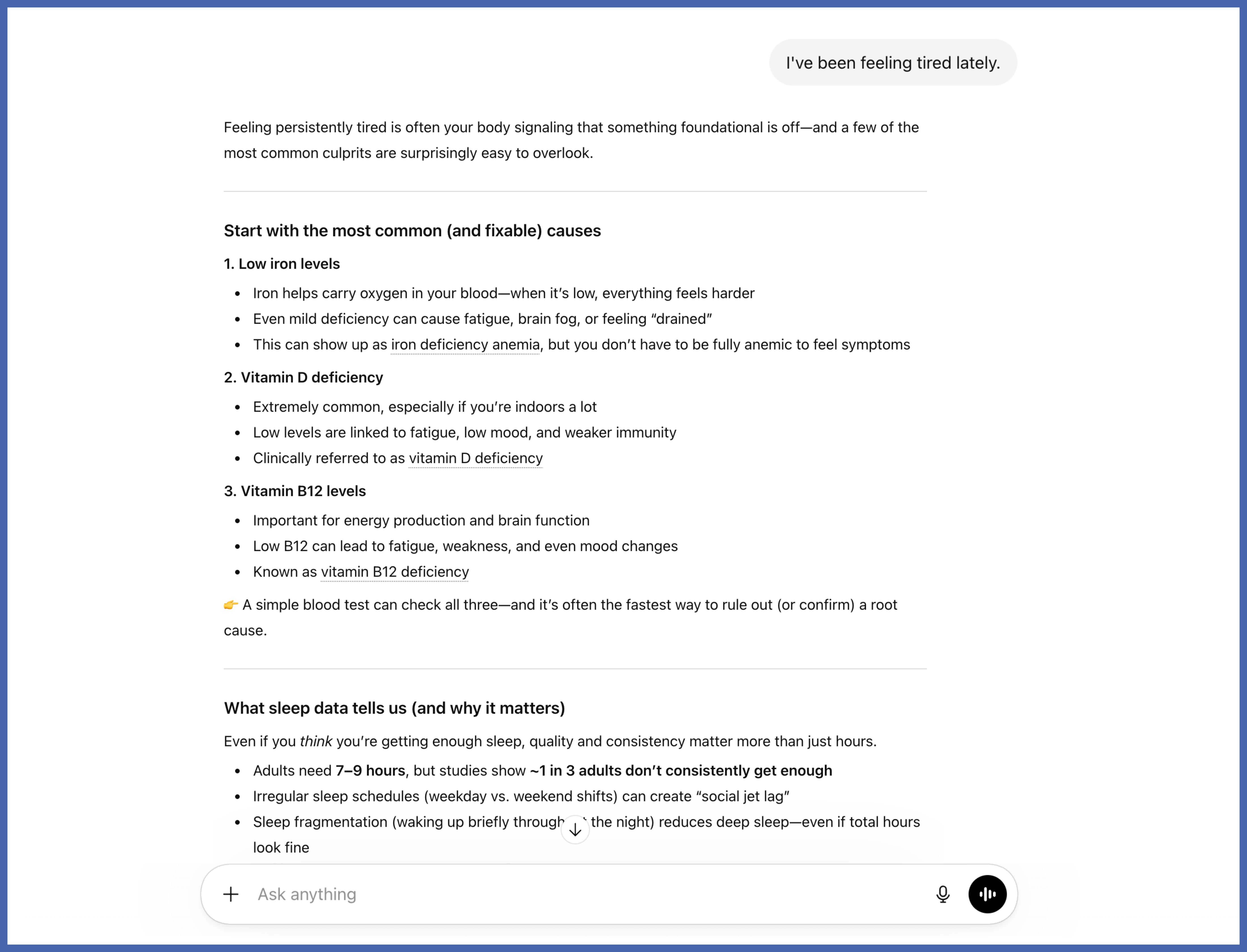
In the first health system, AI provides a well-reasoned answer. It suggests checking iron levels, vitamin D levels, or explains potential causes. It might even cite sleep data trends. And then the conversation ends.
The patient must navigate to a portal.
Log in or reset a password.
Search for labs.
Confirm insurance coverage.
Call scheduling.
Wait on hold.
No lab is automatically scheduled.
No eligibility is verified.
No reminder is triggered.
No care gap is closed.
The AI was intelligent, but the system was fragmented. Even when the advice is correct, friction prevents follow-through and the completion of the desired outcome. The patient’s intent is lost between systems. What began as insight becomes abandonment. This is where most health systems are stuck today.
Health System Two: AI as Action
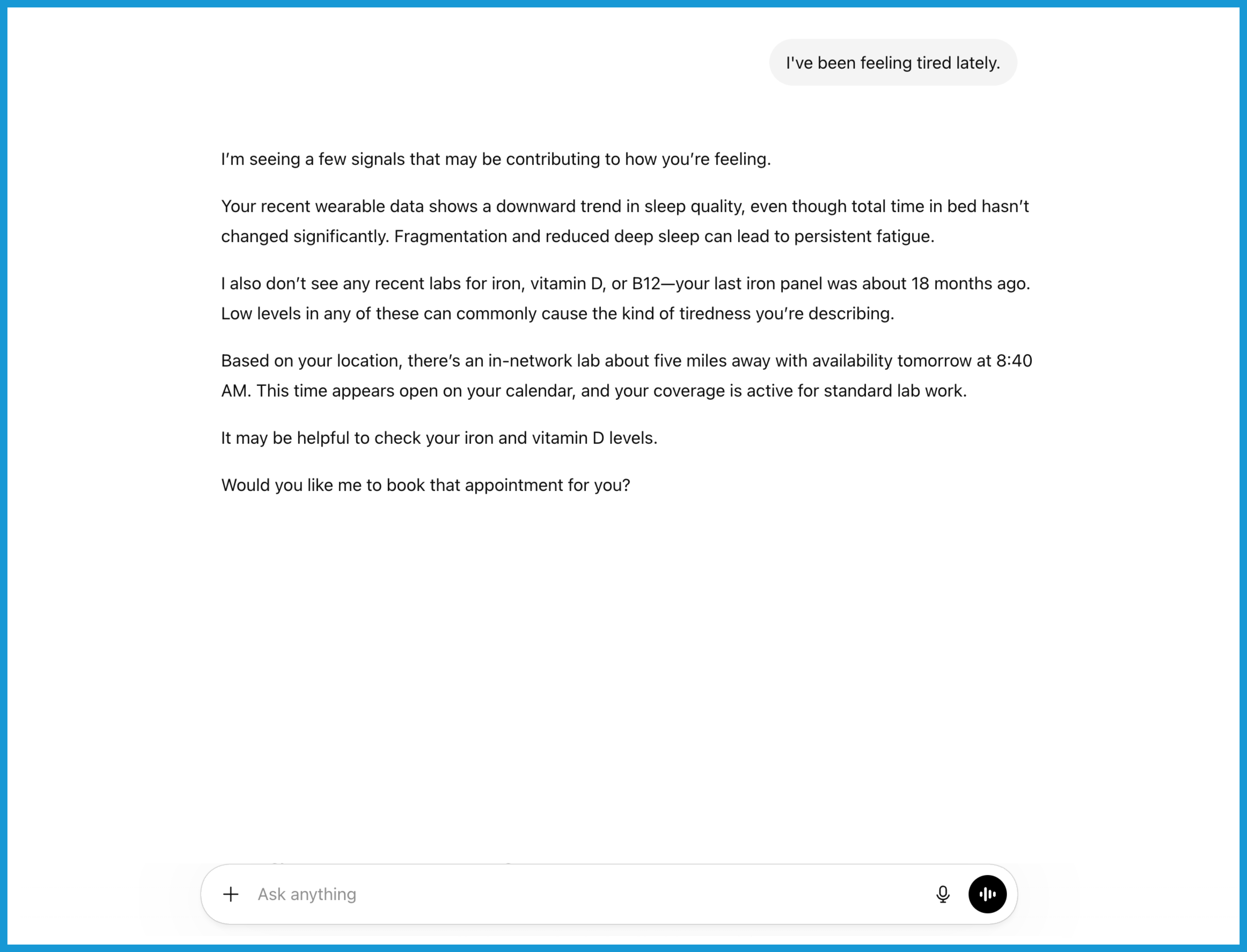
Now imagine the same patient in an orchestrated experience.
AI recognizes that the patient’s wearable data shows declining sleep quality. It notes that their last iron panel was 18 months ago. It identifies an in-network lab location five miles away. It verifies coverage in real time.
Instead of suggesting an article, it responds: “It may be helpful to check your iron and vitamin D levels. There’s an in-network lab near you with availability tomorrow at 8:40 AM, which appears available on your calendar. Would you like me to book it?”
With one confirmation, the lab is scheduled. Insurance is verified. A reminder is automatically set, all in the background. Follow-up is queued based on results.
The journey becomes: Symptom → Insight → Action → Follow-up
Using the same AI reasoning, a completely different outcome emerges. The difference is not the model. It’s orchestration.
The Opportunity: Connecting What Already Exists
Interoperability standards make records more accessible than ever. Eligibility systems can verify coverage. Scheduling APIs can book appointments. Workflow engines can trigger reminders and follow-up. AI has the ability to analyze wearable data, review historical labs, identify in-network options, and initiate workflows within a single conversation.
But most health systems are not connecting these components into a cohesive, system-owned experience, despite the fact they have made the digital investments and have the assets available.
There is a fundamental difference between AI that answers health questions and a system that completes healthcare tasks. The former provides guidance. The latter delivers desired outcomes.
Patient experience orchestration connects identity, data, workflows, and third-party services into a unified engagement layer that turns digital intent into engaged patients and completed care visits. AI generates insight, while orchestration ensures that insight flows directly into scheduling, coverage verification, lab booking, reminders, and follow-up.
Health systems implementing this connected approach are already seeing measurable results. Personalized reminders delivered within an orchestrated experience have driven 61% engagement rates compared to typical health and medical app benchmarks of 10–15%. When friction is removed and identity is unified, patients act.
Without orchestration, the loop breaks across disconnected portals and point solutions. With orchestration, digital intent converts into completed care.
The Competitive Shift: The AI Action Layer
Health systems once competed on facility footprints, geography, brand, and networks. The new competitive frontier is the AI action layer: who can convert conversational insight into booked care within the same experience.
When a patient hears, “You may want to check your vitamin D,” the question is no longer whether the reasoning is sound. The question is what happens next.
For Health System One, the patient gets information.
For Health System Two, the patient gets actionable follow-up.
Owning that action layer strengthens retention, prevents leakage, and drives measurable ROI. It transforms digital engagement from passive information consumption into active care navigation.
Praia Health’s orchestration platform was built for this moment: connecting identity, data, and workflows into one access point, so that when AI generates intent, the health system can execute. The goal is not to replace portals or AI tools, but to unify them into a branded, system-owned experience that turns insight into action.
Patients are not waiting for an in-person appointment to ask questions. They are engaging AI late at night, referencing sleep data from last night, and making decisions in real time. If conversational AI becomes the primary place where patients express intent, health systems must be embedded directly in that flow. Not as a redirector, but as an executor.
The organizations that win in this next phase of digital health will not simply deploy better AI; they will build the connective tissue between reasoning and execution.
Health systems that utilize patient facing AI solutions as purely content channels or gated within a closed ecosystem will fall behind. AI needs to be embedded as part of the external and internal care journey.
Health systems that convert insight into scheduled care will define the next era of consumer healthcare.
Learn more about the Praia Health platform that makes this orchestrated reality possible for health systems.